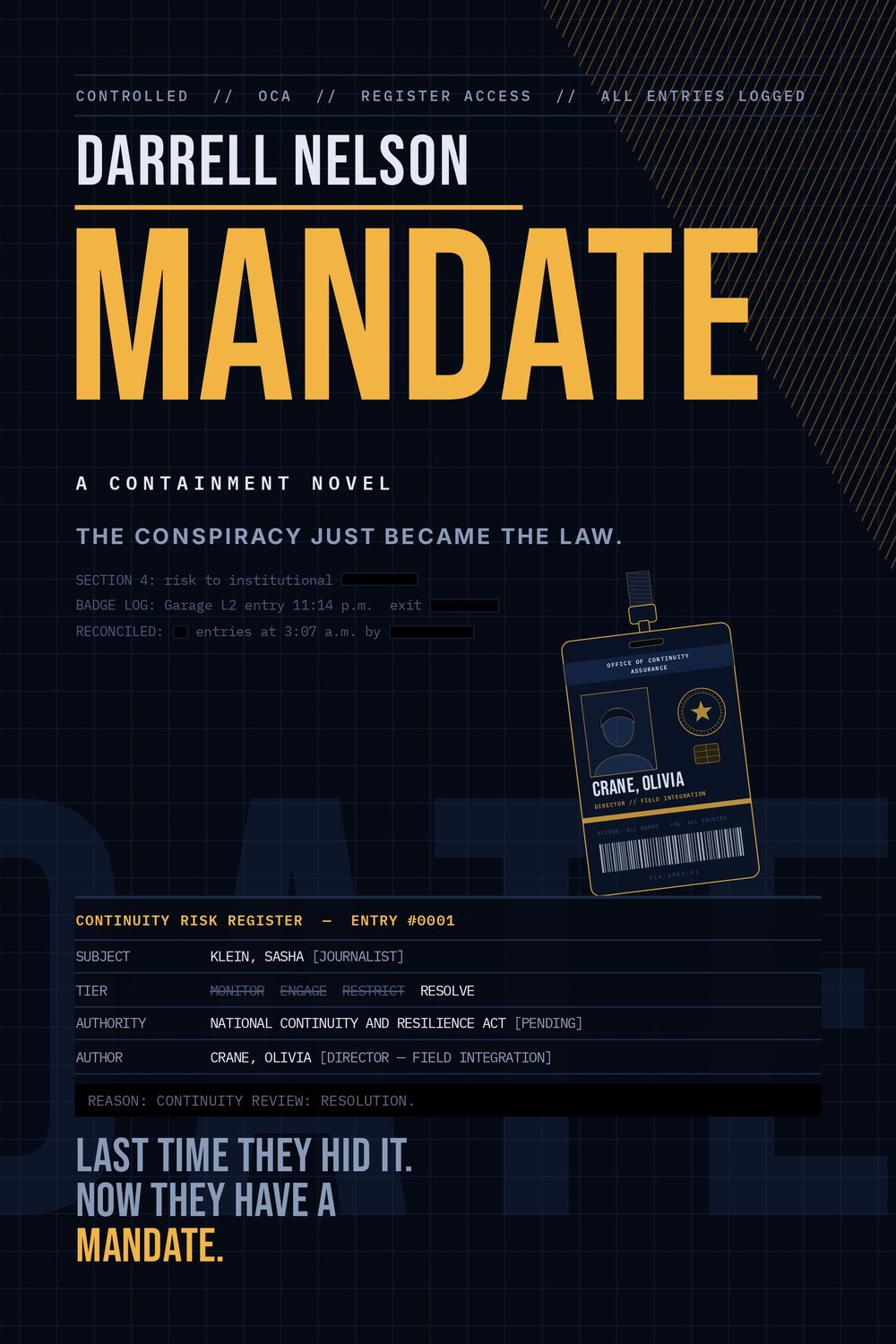
A year after the conspiracy was buried, its architect carries a federal badge and a list of everyone who knows too much, and the journalist at the top of it has to expose something that now has the law on its side.
The Full Cover.
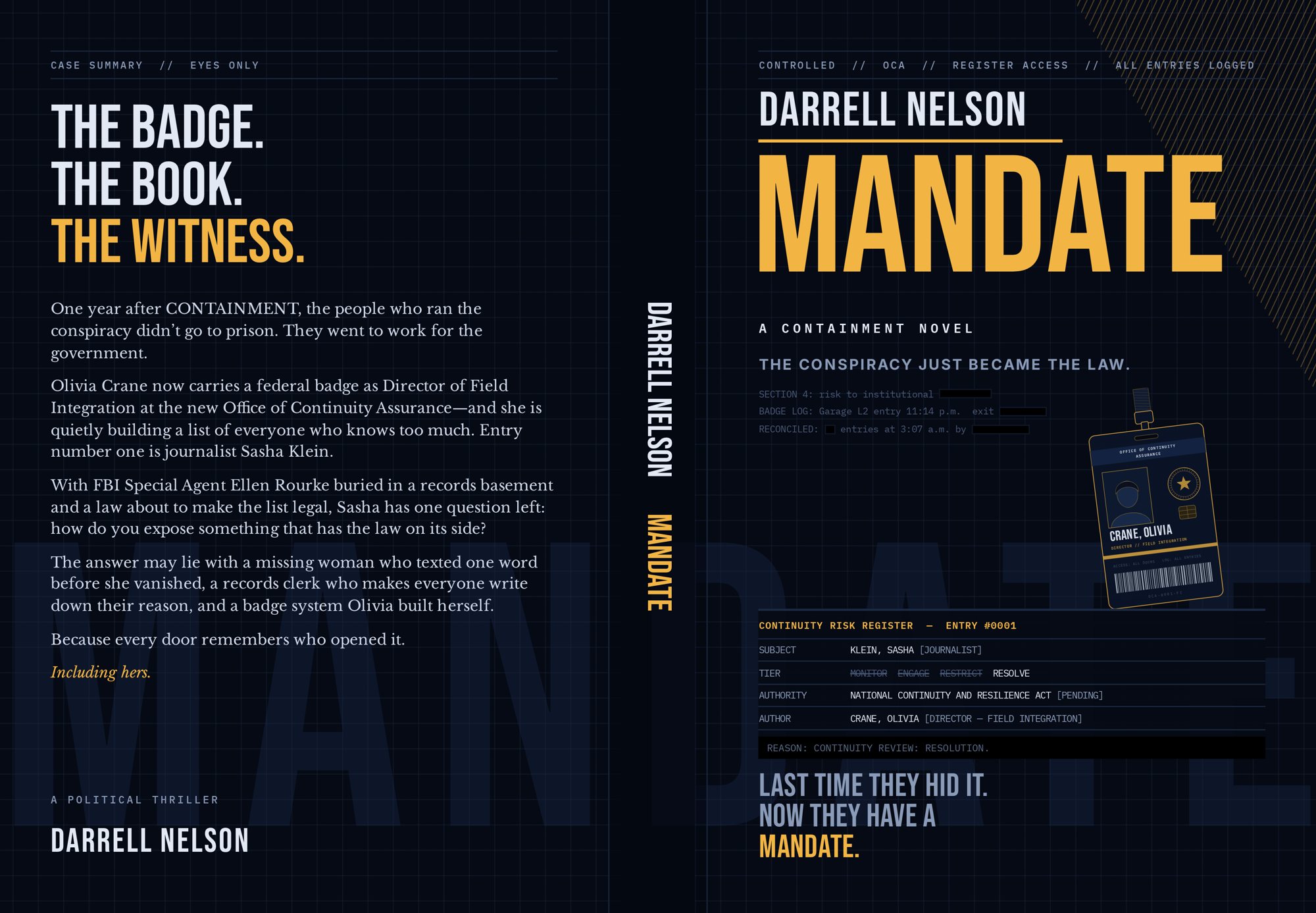
Back, spine and front, the way it wraps the printed book.
The Story.
The badge. The book. The witness.
One year after CONTAINMENT, the people who ran the conspiracy didn’t go to prison. They went to work for the government.
Olivia Crane now carries a federal badge as Director of Field Integration at the new Office of Continuity Assurance—and she is quietly building a list of everyone who knows too much. Entry number one is journalist Sasha Klein.
With FBI Special Agent Ellen Rourke buried in a records basement and a law about to make the list legal, Sasha has one question left: how do you expose something that has the law on its side?
The answer may lie with a missing woman who texted one word before she vanished, a records clerk who makes everyone write down their reason, and a badge system Olivia built herself.
Because every door remembers who opened it. Including hers.
Never charged. Now a federal director with a badge, an office and a register of names.
Entry #0001. Still publishing. Still refusing to be managed.
Still FBI. Buried in a records basement, where every file is a door.
Whitaker’s campaign manager. One text, “NOW,” and then she disappeared.
Chapter One.
Chapter 1
The Badge
Delaney’s coat snapped in the wind beside her.
For a moment the three of them watched the courthouse doors close. The woman with the badge had disappeared inside. Her car remained at the curb, engine running, exhaust folding into the cold.
Sasha put her phone away.
“Well,” she said. “We’ve done the standing outside part.”
Rourke looked at the doors. “Usually my favorite part.”
Nobody moved immediately. Below them, two groups of protesters shouted versions of the same word at each other. Freedom. Security. Depending on who was holding the sign, one meant the absence of the other. A television crew adjusted its light. The reporter practiced an expression of impartial concern in the dark glass of a parked van.
Sasha’s hands were warm inside her pockets. Steady. That still surprised her sometimes, the body’s ability to stop announcing what it knew.
“Together?” Delaney asked.
“For the metal detector,” Rourke said. “After that we’ll see.”
Inside, the air smelled of wet wool and floor polish. A guard sat behind a plastic tray littered with the grit from other people’s keys. Sasha emptied her pockets. Phone. Keys. A receipt with a number on the back. He watched the phone longer than the rest.
“Hearing?”
“Joint subcommittee,” she said.
He pointed past the detector. “Upstairs. Old ceremonial courtroom.”
“General Assembly lose its lease?” Sasha asked.
The guard gave her the tired look of a man whose building had become an explanation. “Renovation. Their building’s under renovation. We get the hearings until they’re finished.”
Rourke collected her things without offering him a joke. Delaney waited until Sasha had put her phone back in her coat. Small courtesies, arranged like security.
On the landing, a printed arrow had been taped across a marble plaque honoring somebody dead. The tape was already peeling. Sasha followed it into the warmth.
Gallery pews. Radiator hiss. Portraits of judges who had managed to look disappointed before anybody arrived.
The old courtroom had been fitted with microphones and extension cords. Staffers moved between the counsel tables with paper cups. At the front, a young man in a dark suit bent toward an older legislator and listened with his whole face.
Caleb Wren.
Thirty-eight, according to the biography Sasha had read on the drive down. State senator. Sponsor. A Senate campaign gathering expensive friends. He had the kind of handsome earnestness that made disagreement feel unnecessarily cruel.
Whitaker had looked good under lights too.
Sasha chose an aisle seat halfway back. Rourke sat beside her. Delaney took the end of the pew behind them, where he could watch both doors without turning his head.
The agenda lay on every other seat.
Community. Continuity. A pair of soft hands around a hard thing.
Sasha photographed the page. Across the aisle, Warren Finch leaned close to a man with a visitor badge and said something that made them both smile. No microphone near him. No nameplate. Just the easy posture of a man attending a demonstration of something he might buy.
“Finch,” she whispered.
“Saw him,” Rourke said.
Delaney leaned forward. “Wren’s chief of staff. Standing by the side door.”
Sasha looked without making it obvious. A narrow man sorting folders.
“Whitaker’s advance operation,” Delaney said. “Used to get rooms ready for him.”
“Still does,” Sasha said.
Wren tapped his microphone. The little squeal quieted the room more effectively than his smile.
He thanked the courthouse staff for accommodating the joint General Assembly subcommittee. He thanked the public for participating. He said the bill represented a careful balance between individual liberty and the responsibility to maintain essential institutions.
Sasha wrote careful balance in her notebook.
It was what people said before they put a thumb on the scale.
Wren called the next witness.
Olivia crossed from a side row carrying a thin folder. Clean coat over her arm. Dark hair pinned back. The badge was clipped to her belt, exposed as she sat.
Sasha had filmed that badge outside. Now she could see the department seal, the photograph, the row of small print beneath it.
Olivia adjusted the microphone once.
“For the record,” Wren said, “please identify yourself and your position.”
“Olivia Crane. Director of Field Integration, Office of Continuity Assurance, U.S. Department of Homeland Security.”
Rourke went still beside Sasha.
There it was.
Not a cover whispered in a garage.
A title spoken into the record.
Olivia thanked the subcommittee for its attention to operational realities. Her voice carried without effort. She described the gap between identifying a destabilizing pattern and coordinating a proportionate response. She did not describe who decided what a pattern was.
“The Commonwealth’s proposed framework would allow existing agencies to cooperate before a continuity event becomes a public emergency,” she said.
Sasha heard Theo coughing on a warehouse floor.
Existing agencies.
“And the federal relationship?” Wren asked.
“The National Continuity and Resilience Act is pending in Congress. Virginia’s pilot partnership would provide a disciplined model for implementation while preserving appropriate local oversight.”
Preserving. Appropriate. Local.
Each word had a lid.
A legislator asked whether the measure created new policing powers. Olivia said it aligned existing authorities with emerging risks. Another asked about protected speech. Olivia said criticism was not a risk category in itself.
In itself.
Sasha underlined it.
“Sustained conduct may have effects distinct from the professed intention of the individual,” Olivia said.
Wren nodded, taking this seriously. Maybe he thought he was. That was the useful kind.
“Could you give us a practical example?”
Olivia opened her folder, though she did not look down.
“A person repeatedly disseminating operationally sensitive material may create risks to employees, emergency response, and public confidence, even when the person characterizes that dissemination as public-interest activity.”
Sasha felt Rourke’s knee shift against the pew.
No squeeze of the hand. No whispered warning.
They had learned not to make comfort look like confirmation.
Chapter 1 of 60 · ~94,000 words
Get the Book.
Coming soon in hardcover, paperback and ebook. 437 pages.
Amazon
Hardcover, paperback and Kindle ebook. Link goes live on release day.
Barnes & Noble
Hardcover, paperback and Nook ebook. Link goes live on release day.